

One DWI arrest in Texas starts two separate cases. The criminal case is the one everybody knows about. The other one is with the Department of Public Safety, it is about your license, and its first deadline comes long before your first court date.
We are an insurance agency, not a law firm, so we will stay on our side of the line: the license, the SR-22 and the fees. Here is that side, in the order it happens.
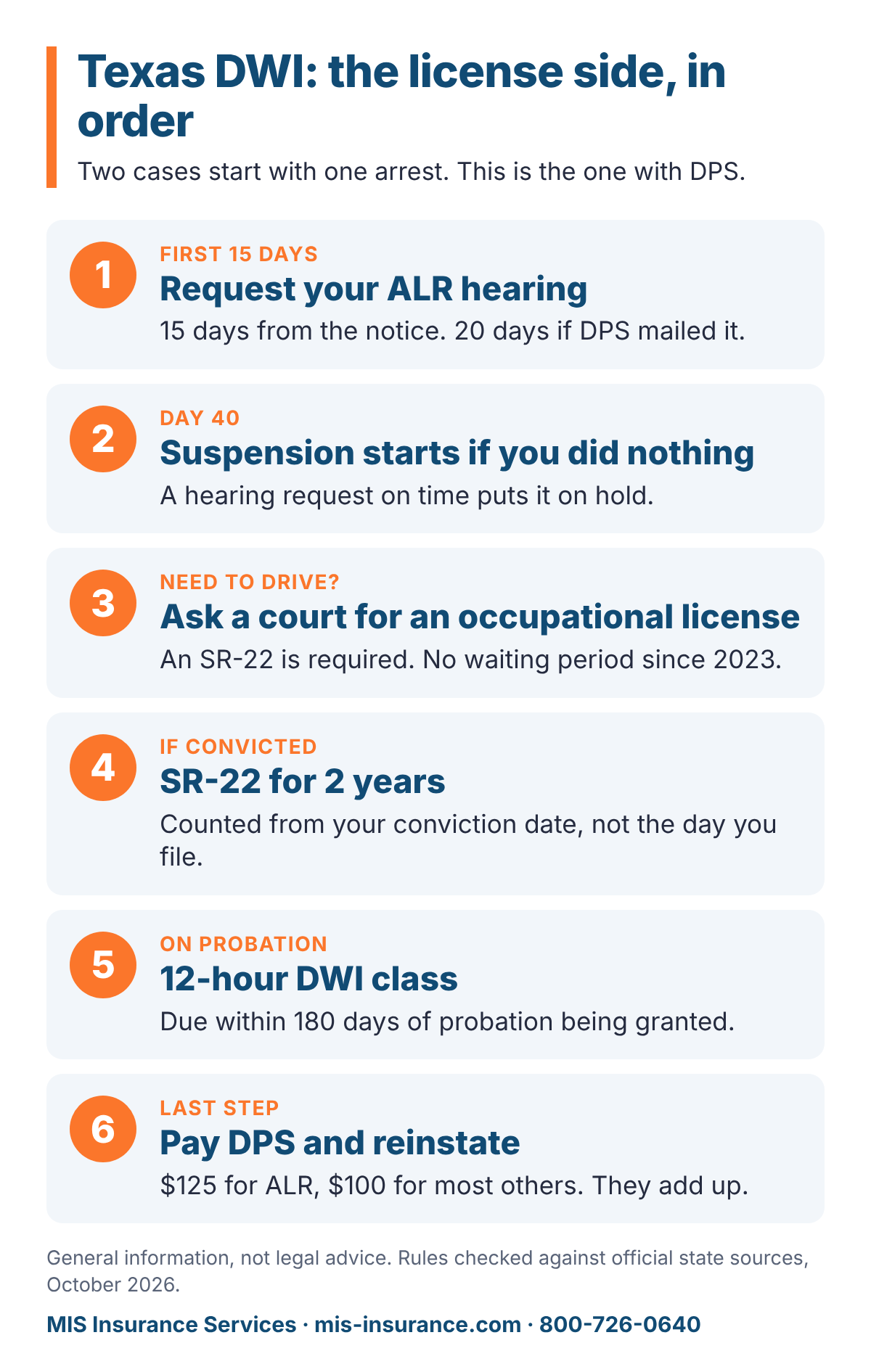
The short version:
Step 1: You have 15 days to ask for a hearing
If you failed or refused the breath or blood test, DPS moves to suspend your license under the Administrative License Revocation program, called ALR. You can contest it, but only if you ask in time.
- 15 days from the day the officer handed you the notice.
- 20 days from the mailing date if DPS mailed the notice, which is common in blood-test cases.
You can request the hearing online, by mail, email, phone or fax. The details are on the DPS ALR page.
If you do nothing, the suspension starts automatically on the 40th day after you were handed the notice. For a mailed notice, it is the 40th day after you are presumed to have received it. If you ask on time, the suspension is put on hold until a judge decides.
The ALR case does not wait for the criminal case, and it does not depend on it. DPS says so directly: the ALR suspension is unrelated to the criminal court proceedings.
Step 2: How long the ALR suspension lasts
For adults 21 and over:
| What happened | First time | Prior alcohol or drug contact in the last 10 years |
|---|---|---|
| Failed the test (0.08 or higher) | 90 days | 1 year |
| Refused the test | 180 days | 2 years |
When it ends, DPS charges a $125 reinstatement fee before you get your license back.
Step 3: If you need to drive, ask for an occupational license
An occupational driver license lets you drive to work, to school and for essential household errands while your regular license is suspended. A court grants it, and DPS issues it.
Where you ask. For an ALR suspension, you petition a justice, county or district court in the county where you live or where the arrest happened. If the suspension came from a conviction, the law sends you back to the court that convicted you.
What you need. An SR-22 is on the list. No SR-22, no occupational license. You also have to pay any reinstatement fees you owe first.
The waiting period is gone. A lot of websites still say you must wait 90 days, 180 days or a year before you can get one. That rule was removed on September 1, 2023. A judge can still say no, especially with more than one DWI conviction in the past 10 years.
The limits. Normally up to 4 hours of driving in any 24, or up to 12 if you show the court you need it. If the court restricts you to a vehicle with an ignition interlock, those time and travel limits do not apply.
The cost at DPS. $10 a year. The court charges its own filing fee, which varies by county. The signed court order works as your license for 45 days while DPS processes the real one, which DPS says can take about 21 business days.
Step 4: What the criminal case does to your license
This is your attorney’s territory, so only the parts that touch your license and your wallet.
- A conviction can bring its own suspension: 90 days to 1 year for a first DWI. But for many first-time offenders who get probation with the required DWI education class, the law generally keeps DPS from suspending the license for the conviction. Ask your attorney which applies to you.
- The yearly surcharges are gone. Texas repealed the Driver Responsibility Program in 2019. What replaced it is a one-time state fine on a final DWI conviction: $3,000 for a first conviction in 36 months, $4,500 for a second, and $6,000 if the test showed 0.15 or higher. That is on top of the regular fine, and a court can waive it for someone who cannot pay.
Step 5: The SR-22, and when the two years start
An SR-22 is not a kind of insurance. It is a certificate from your insurance company telling DPS that you carry at least the Texas minimum liability coverage: $30,000 per person, $60,000 per accident and $25,000 for property damage.
After a DWI conviction, DPS requires you to keep an SR-22 on file for two years from the date of the conviction.
Read that date again, because it is the detail people get wrong. The two years run from the conviction, not from the day you buy the policy. DPS’s own example: file a year late and you have one year left, not two. Waiting does not shorten anything. It only means you spent that year unable to reinstate.
Three more things worth knowing:
- An ALR suspension by itself usually does not call for an SR-22. It comes in with a conviction, or the moment you ask for an occupational license. Your License Eligibility page (Step 8) shows exactly what DPS wants from you.
- If the policy lapses, DPS finds out. Your insurance company notifies DPS automatically. Your license is suspended again, and you need a new SR-22 plus a $100 reinstatement fee.
- No car? You still need one. DPS says that if you do not own a vehicle you can get a Texas non-owner SR-22 policy. We wrote a full guide to Texas non-owner SR-22 coverage.
This is the part we handle. You can buy the policy and get your certificate from our Texas SR-22 page in a few minutes, and we send the filing to DPS. If you are wondering how long DPS takes after that, we covered DPS processing times here.
Step 6: The DWI class
A first offender placed on probation has to complete the 12-hour DWI Education Program unless the judge waives it. The deadline is 180 days from the day probation is granted, unless the judge extends it. Miss it and DPS revokes your license until you show proof, and adds a $100 fee.
Repeat offenders take the longer DWI Intervention Program, about 32 hours.
These programs are regulated by the Texas Department of Licensing and Regulation, and state law allows them to be offered online or in person. TDLR has a course finder. Check that the provider is on it before you pay.
Step 7: Ignition interlock, if it applies
Not everyone gets one. On probation it is mandatory if your test showed 0.15 or higher, if you have a prior DWI-type conviction, or if you were under 21 at the time. It is also required with deferred adjudication for DWI unless the judge waives it after an evaluation, and it is usually a bond condition on a second or later arrest. Otherwise it is up to the judge.
If you are ordered to have one, DPS issues an interlock restricted license for $10. Devices are installed by vendors certified by DPS.
Step 8: Paying DPS and getting your license back
Everything DPS wants from you is listed on the License Eligibility site. Log in, and it shows your status, what is missing and what you owe. You can pay there.
The fees are charged per suspension, so they add up:
| Fee | Amount |
|---|---|
| ALR reinstatement | $125 |
| Reinstatement after a DWI conviction suspension | $100 |
| Reinstatement after an SR-22 lapse | $100 |
| DWI class not completed on time | $100 |
| Occupational license | $10 a year |
| Interlock restricted license | $10 |
DPS will not reduce these, waive them or take installments. One piece of good news: if your ALR suspension is not upheld at the hearing, there is no ALR fee.
We also have a separate walk-through of reinstating a Texas license with an SR-22.
The three mistakes that cost people the most time
- Missing the 15 days. It is the only step with no second chance.
- Waiting to buy the SR-22. The clock started at your conviction either way.
- Letting the policy lapse. One missed payment can mean a new suspension and another $100. Put it on autopay.
Common questions
If my DWI is dismissed, does the ALR suspension go away?
Not automatically. They are separate cases, so a dismissal or a reduced charge does not undo the ALR suspension by itself. An acquittal is different: after an acquittal, the law requires DPS to rescind the ALR suspension and charge no fee. Ask your attorney which one you have.
Can I get an SR-22 if my license is suspended right now?
Yes. The SR-22 is usually one of the things you need in order to get it back.
How long does the SR-22 stay on my policy?
Two years from your conviction date. A new conviction during that time can extend it.
Do I have to tell my insurance company about the DWI?
Answer every question on the application truthfully, and tell your agent up front. It gets you an accurate price, and leaving a DWI off an application can get a policy cancelled later.
Need the SR-22 part handled today?
That is the one step on this list we can take off your plate. Get a quote and your certificate on our Texas SR-22 page, or call 800-726-0640, Monday through Friday, 8 am to 6 pm Pacific.
This article is general information, not legal advice. For anything about your criminal case, talk to a Texas attorney. Rules and fees change. Last reviewed October 2026.
Sources
- Texas DPS: Administrative License Revocation (ALR) program
- Texas DPS: occupational driver license
- Texas DPS: SR-22 certificate
- Texas DPS: SR-22 questions and answers
- Texas DPS: alcohol-related offenses
- Texas DPS: reinstatement fees
- Texas DPS: ignition interlock devices
- Texas Transportation Code, Chapter 521 (occupational licenses, suspensions)
- Texas Transportation Code, Chapter 709 (state traffic fines)
- Texas Department of Licensing and Regulation: court-ordered programs