

In most states, the cheapest motorcycle policy you can legally buy pays for the other person. It does not pay for you, your bike, or the $600 helmet that just slid across the freeway.
That surprises a lot of riders, because the policy says “insurance” on it and they assume they are insured. So before you pick the lowest number on the quote, here is what the state actually makes you carry, what that leaves out, and how to decide what is worth adding.
What your state makes you carry
MIS is licensed in nine states. Every one of them requires liability insurance (or another approved form of financial responsibility) to ride on public roads. The numbers below are the minimums, written the way agents say them: injury per person / injury per accident / property damage.
| State | Minimum liability | Helmet required for |
|---|---|---|
| California | $30,000 / $60,000 / $15,000 | All riders and passengers |
| Texas | $30,000 / $60,000 / $25,000 | Under 21 (21 and over can skip it with a safety course or health coverage) |
| Arizona | $25,000 / $50,000 / $15,000 | Under 18 |
| Colorado | $25,000 / $50,000 / $15,000 | Under 18 |
| Washington | $25,000 / $50,000 / $10,000 | All riders |
| Oregon | $25,000 / $50,000 / $20,000, plus uninsured motorist | All riders and passengers |
| Nevada | $25,000 / $50,000 / $20,000 | All riders and passengers |
| Idaho | $25,000 / $50,000 / $15,000 | Under 18 |
| Utah | $30,000 / $65,000 / $25,000 | Under 21 |
Two of these changed recently. California’s minimums went up on January 1, 2025, from the old 15/30/5. Utah’s went up the same day. Policies issued or renewed since then have to meet the new numbers, so if you are comparing an old quote to a new one, that is part of why the price moved.
One more thing riders from out of state miss: Washington did not require motorcycle insurance at all until July 2019. It does now.
What that minimum pays for, and what it does not
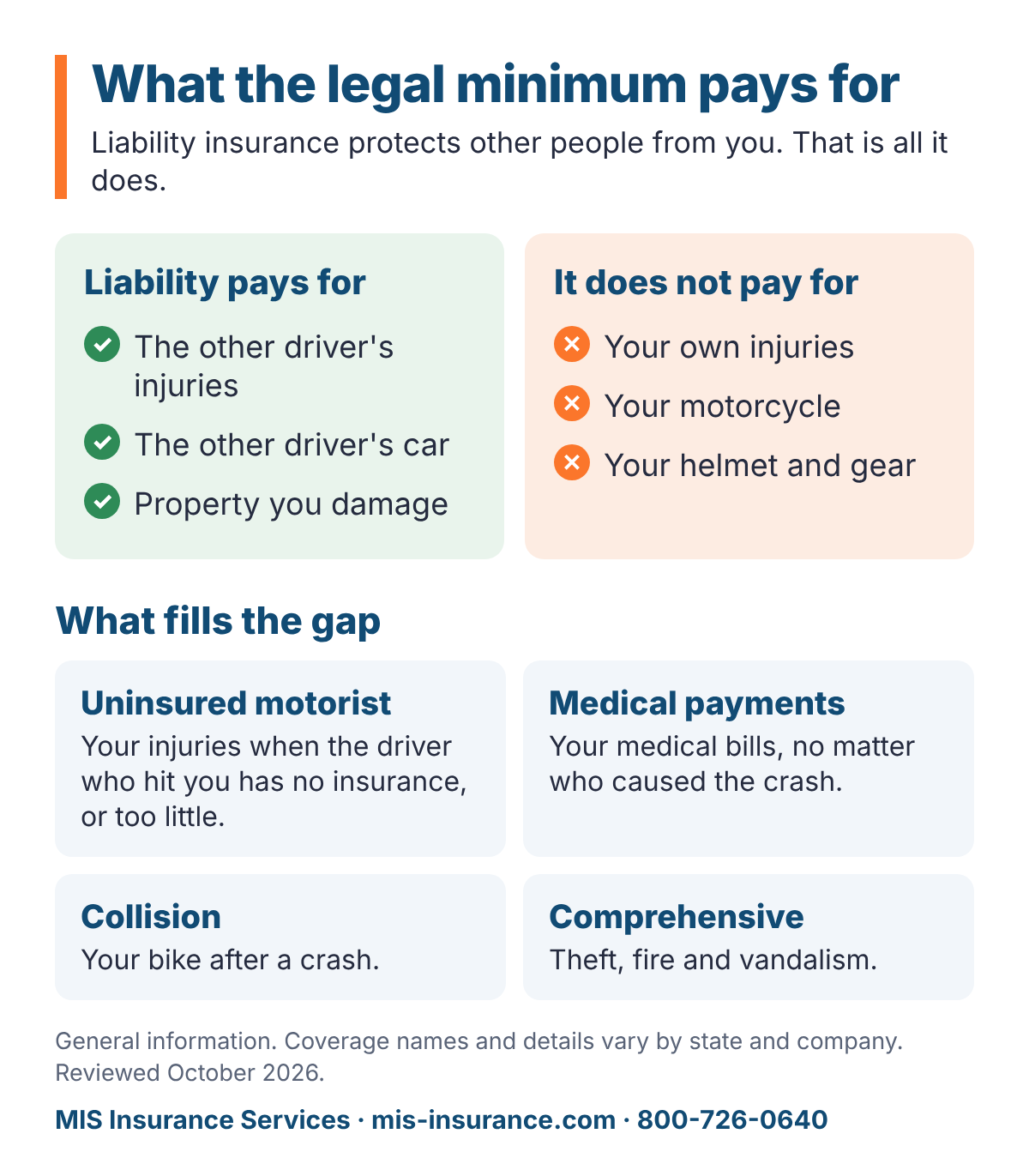
Liability is there to protect other people from you. If you cause a crash, it pays for their injuries and their car, up to your limits. That is the whole job.
Nevada’s Division of Insurance puts it plainly in its guide for riders: the required liability coverage does not pay for your injuries or for damage to your motorcycle. The same is true everywhere else.
So in most states, a rider with a minimum policy who gets rear-ended by a driver with no insurance has a legal policy and nothing to collect from. (Oregon is the exception among our states. It builds $25,000 / $50,000 of uninsured motorist coverage into every policy, though that still does nothing for your bike.) That gap is what the rest of this guide is about.
Four coverages worth pricing
1. Uninsured and underinsured motorist
This is the one we would add first. It pays for your injuries when the driver who hit you has no insurance or not enough.
How likely is that? According to the Insurance Research Council’s latest figures, about 15% of drivers nationwide were uninsured in 2023. In our states it runs higher in some places than you would guess:
- California: about 20%
- Colorado: about 20%
- Washington: about 19%
- Oregon and Texas: about 15%
- Nevada and Arizona: about 11%
- Idaho and Utah: about 6%
In California that is one driver in five. On a bike, with no steel around you, the injuries from the same crash are worse, and the bills are bigger.
2. Medical payments
Medical payments coverage pays your medical bills, and your passenger’s, no matter who caused the crash. It also covers the crash nobody else was part of: gravel in a corner, a deer, a wet painted line. Nevada’s regulator notes it is the only coverage on your own policy that pays your medical costs when the accident involves just you.
If you have good health insurance, you may need less of it. If your deductible is high, a few thousand dollars of medical payments coverage can cover that deductible.
3. Collision and comprehensive
Collision fixes or replaces your bike after a crash. Comprehensive covers the things that are not a crash: theft, fire, vandalism. If you have a loan on the bike, your lender will almost always require both.
If the bike is paid off, the question is simple. Could you replace it out of pocket next week? If not, keep them.
4. Accessories and riding gear
Here is the one people find out about too late. Many policies only cover the factory parts on your motorcycle, or cap what they pay for anything you added. Custom paint, chrome, a new exhaust, saddlebags, a sidecar or trailer: ask what the limit is and whether you can raise it.
Helmets, jackets and cameras are a separate question. Whether they are covered, and for how much, depends on the company and usually on whether you carry comprehensive and collision. Ask before you need it.
Riding with a passenger? Ask whether passenger liability is included in your policy. Some companies build it into the liability coverage. With others it is a separate line you have to add.
Why riders need more than drivers do
This is the part nobody enjoys reading, so we will keep it short.
The National Highway Traffic Safety Administration counted 6,228 motorcyclists killed in 2024, which was 16% of all traffic deaths. Mile for mile, the fatality rate for motorcyclists was almost 27 times the rate for people in passenger cars.
Helmets help. The Insurance Institute for Highway Safety says studies have found helmets cut the risk of death by 37% to 42%. NHTSA’s numbers show the difference a helmet law makes: where helmet use was known, 48% of the motorcyclists killed in 2024 in states without a universal helmet law were not wearing one, compared with 11% in states with one.
None of that is a reason not to ride. It is the reason the coverage that protects you matters more on a bike than it does in a car.
What moves the price
- The type of bike. This can matter more than what you paid for it. A sport bike can cost more to insure than a pricier cruiser. An Insurance Institute for Highway Safety study found a driver death rate for supersport bikes about four times the rate for cruisers and standard bikes.
- Your record and experience. Tickets, accidents and how long you have been licensed to ride.
- Where the bike sleeps. Your ZIP code, and whether it is garaged.
- Your limits and deductibles. Higher limits cost more. Higher deductibles cost less.
- Discounts. Many companies give a discount to graduates of a rider course such as the Motorcycle Safety Foundation’s. There are also discounts for insuring more than one bike and for having your other policies with the same company.
Our advice on price is always the same. Ask for the quote two ways: once at the state minimum, and once with higher limits and uninsured motorist added. When you can see both numbers side by side, the decision usually makes itself.
A quick way to decide
- Older bike, paid off, good health insurance. Liability above the minimum, uninsured motorist, and a modest amount of medical payments. You can think about skipping collision.
- Newer or financed bike. All of the above plus collision and comprehensive, and enough accessory coverage for what you have added.
- You carry a passenger regularly. Confirm passenger liability, and look hard at higher medical payments and uninsured motorist limits, because now there are two of you.
Need an SR-22 and only ride a motorcycle?
If a court or the DMV has told you to file an SR-22 and a motorcycle is your only vehicle, call us before you buy anything. How the filing is written matters. A filing tied only to your bike may not cover you when you drive a car, and the fix is easy if you set it up correctly from the start. SR-22 filings are what we do all day, so this is a five-minute phone call. Our SR-22 page explains the basics.
Common questions
Does my car insurance cover my motorcycle?
Almost never. Personal auto policies are written for four-wheel vehicles and typically exclude motorcycles, so the bike needs its own policy. Check yours, but do not count on it.
Do I need insurance if the bike is in storage?
It depends on your state and on whether the bike is still registered. Ask before you cancel. A gap in coverage can cost you more later than the months you saved. If you live where winters are long, ask about a lay-up policy, which keeps comprehensive in place while the bike is parked.
Will a safety course lower my rate?
With many companies, yes. Tell your agent which course you took and when.
Is the state minimum ever enough?
It is enough to be legal. Whether it is enough for you comes down to what you would lose if you were hurt and the other driver had nothing. For most riders, that is worth at least a second quote.
Get a motorcycle quote
We have been insuring drivers and riders since 2009, and we will price it both ways so you can see the difference. Start on our motorcycle insurance page or call 800-726-0640, Monday through Friday, 8 am to 6 pm Pacific.
This article is general information, not legal advice. Laws and minimum limits change. Last reviewed October 2026.
Sources
- California DMV: insurance requirements
- California Department of Insurance: 2025 changes to minimum limits
- Texas Department of Insurance: motorcycles
- Texas Transportation Code, Chapter 661 (helmets)
- Arizona DOT: mandatory insurance
- Colorado Division of Insurance: auto insurance
- Oregon DMV: insurance requirements
- Nevada DMV: insurance requirements
- Idaho Department of Insurance: required auto coverage
- Utah Driver License Division: motorcycling in Utah
- Washington Office of the Insurance Commissioner: mandatory auto and motorcycle insurance
- Nevada Division of Insurance: motorcycle insurance
- Insurance Information Institute: uninsured motorists by state (2023)
- Insurance Information Institute: motorcycle insurance
- NHTSA Traffic Safety Facts: Motorcycles, 2024 data
- IIHS: motorcycles and helmet effectiveness
- IIHS: motorcycle helmet laws by state